
Food waste in schools looks like a trash problem because the proof shows up in the trash. Half-eaten trays, unopened milk, untouched fruit, leaky containers, mystery sides, bags that went to the wrong table. By the time anyone sees the bin, the real problem has already happened.
The useful question is not, "How do we make the trash look better?" The useful question is, "Why did this food become waste in the first place?" Sometimes the answer is menu fit. Sometimes it is time to eat. Sometimes it is packaging. Sometimes it is order counts that were more hope than data. Very glamorous stuff, school lunch.
For schools using restaurant-prepared lunch, the waste conversation also includes family ordering, restaurant prep, delivery timing, labels, packaging, and handoff. If those pieces are sloppy, the lunchroom can create waste even when the food itself is good. A good meal can still lose if it arrives late, cold, hard to open, or attached to the wrong student.
Start before the lunchroom trash can
USDA school food waste guidance says the best way to tackle food waste is to make sure students consume what they take. That means planning well, getting students involved in decisions, and teaching why wasted food matters. USDA's school food waste guidance is refreshingly practical on this point: prevention comes before disposal.
The EPA's wasted food scale makes the same basic point. Preventing wasted food and feeding people are more preferred than sending food to landfill, incineration, or the drain. EPA's Wasted Food Scale is not a school lunch menu plan, but it is a useful decision frame: reduce first, recover next, recycle when appropriate, and treat disposal as the last resort.
That order matters because composting cannot rescue a badly planned lunch program. Neither can a nicer bin, a green label, or a poster with a leaf on it. Those things may help, but they work best after the school has handled the first job: reduce the amount of food that becomes waste at all.
Key takeaways
- Food waste in schools is not just a trash-bin problem. It starts with planning, ordering, menu fit, lunch timing, packaging, and handoff.
- The EPA and USDA both point schools toward prevention first: help students consume what they take before relying on disposal fixes.
- Share tables, donation, composting, and packaging changes can help, but each one needs local rules, staffing, sorting, and vendor support.
- Compostable containers only work when the composting facility accepts them and the lunchroom can keep trash out of the compost stream.
- Restaurant-prepared school lunch works better when families order ahead, restaurants prep from real counts, and schools get labeled meals ready for distribution.
Find the waste pattern before choosing the fix
A school does not need a perfect sustainability committee to start. It needs a simple way to see what is actually happening. EPA youth education guidance suggests that reducing waste in schools can begin with a waste audit involving students, staff, parents, and community volunteers. EPA's youth wasted-food resources also point to share tables and student choice as practical school tools.
Keep the audit boring. Boring is good here. Track what comes back: unopened items, untouched entrees, half-eaten sides, messy packaging, fruit, milk, vegetables, or delivered meals that missed the handoff. Look by day, vendor, grade level, menu item, and lunch period. A fourth-grade pizza day and a kindergarten noodle day might have completely different waste causes.
The goal is not to shame children for leftovers. That is a fantastic way to learn nothing. The goal is to collect lunchroom evidence. If unopened sides keep coming back, maybe the portion or choice path is wrong. If warm entrees return half-eaten, maybe time or temperature is the issue. If the same packaging is always abandoned, maybe kids cannot open it quickly enough.
Use ordering data instead of guessing demand
Many waste problems start with production. If the kitchen or restaurant partner has to guess how many students will want a meal, someone is going to be wrong. Too little food creates its own problem. Too much food becomes extra cost, extra packaging, and extra disposal.
Restaurant-prepared school lunch has an advantage when the order system is disciplined: families choose before the day begins. Restaurants can prepare against real orders instead of broad estimates. Schools can receive labeled meals tied to students and classrooms. That structure does not make waste vanish, because lunch is still lunch, but it gives everyone better information than "probably enough chicken wraps."
Pre-ordering also helps with menu feedback. If a meal gets few orders, the school and restaurant know before food is made. If a meal gets orders but comes back uneaten, the problem may be packaging, portion, taste, temperature, or timing. Those are very different fixes. One is a menu decision. One is an operations decision. One is a "please stop using this lid" decision.
Give students choice, but keep the choice controlled
Student involvement matters, but unlimited choice can make the lunch program harder to run. The practical middle is controlled choice: a small set of school-approved meals that students and families understand, restaurants can prepare reliably, and schools can hand off cleanly.
USDA notes that getting students involved in decision-making can help address waste. For a restaurant-powered lunch program, that can mean short surveys, tasting days, grade-level feedback, menu rotation reports, or watching which items are ordered and actually eaten. Schools do not need to turn the cafeteria into a focus group with napkins. They need enough feedback to avoid repeating meals that students clearly do not want.
Good choice is especially important for younger students and picky eaters. A child may reject a meal because the food is unfamiliar, the sauce touched something, the container was hard to open, or the lunch period moved too fast. None of that shows up if the school only asks, "Did they eat?" Better question: what stopped them?
Use share tables and donation carefully
Share tables can keep unopened, allowable food from going straight into the trash. EPA mentions share tables as one school strategy, and many state and district programs publish their own rules. The key phrase is "their own rules." Food safety, supervision, eligible items, temperature control, and local policy matter.
For restaurant-prepared school lunch, share-table rules may be more limited than for sealed cafeteria items. A labeled hot entree that belongs to one student is not the same thing as an unopened packaged fruit cup. Schools should be conservative and specific: what can go on the table, who monitors it, how long it can stay there, what gets discarded, and how allergy concerns are handled.
Donation can also play a role when food is wholesome, safely held, and eligible under local rules. But donation should not become a moral cover for overproduction. If the same extras are donated every week, the school may have a forecasting problem. Donation is useful. Better planning is better.
Composting is useful, but it is not magic
Composting gets a lot of attention because it is visible. Students can see the bin. Parents can see the packaging. Administrators can point to the program. That visibility is useful, but composting is still a system. It needs sorting, acceptable materials, a hauler or on-site process, staff training, student reminders, and a plan for contamination.
USDA's Farm to School program notes that food waste efforts can include gardens, composting food scraps, and tracking waste in cafeterias. It also cites the 2019 School Nutrition and Meal Cost Study, which found that about 21 percent of calories available in school lunches were wasted, including 31 percent of vegetables and 41 percent of milk. USDA's Farm to School food waste article is a useful reminder that waste is measurable, not just a vague feeling after lunch.
A 2024 School Nutrition Association review found that school food waste interventions included educational programs, cafeteria environment changes, and meal schedule changes. Meal schedule changes were most consistently associated with decreases in waste in the studies reviewed. SNA's K-12 food waste review is worth reading before assuming the answer is only a new container. Sometimes the waste fix is lunch timing, not packaging theater.
Evaluate compostable packaging honestly
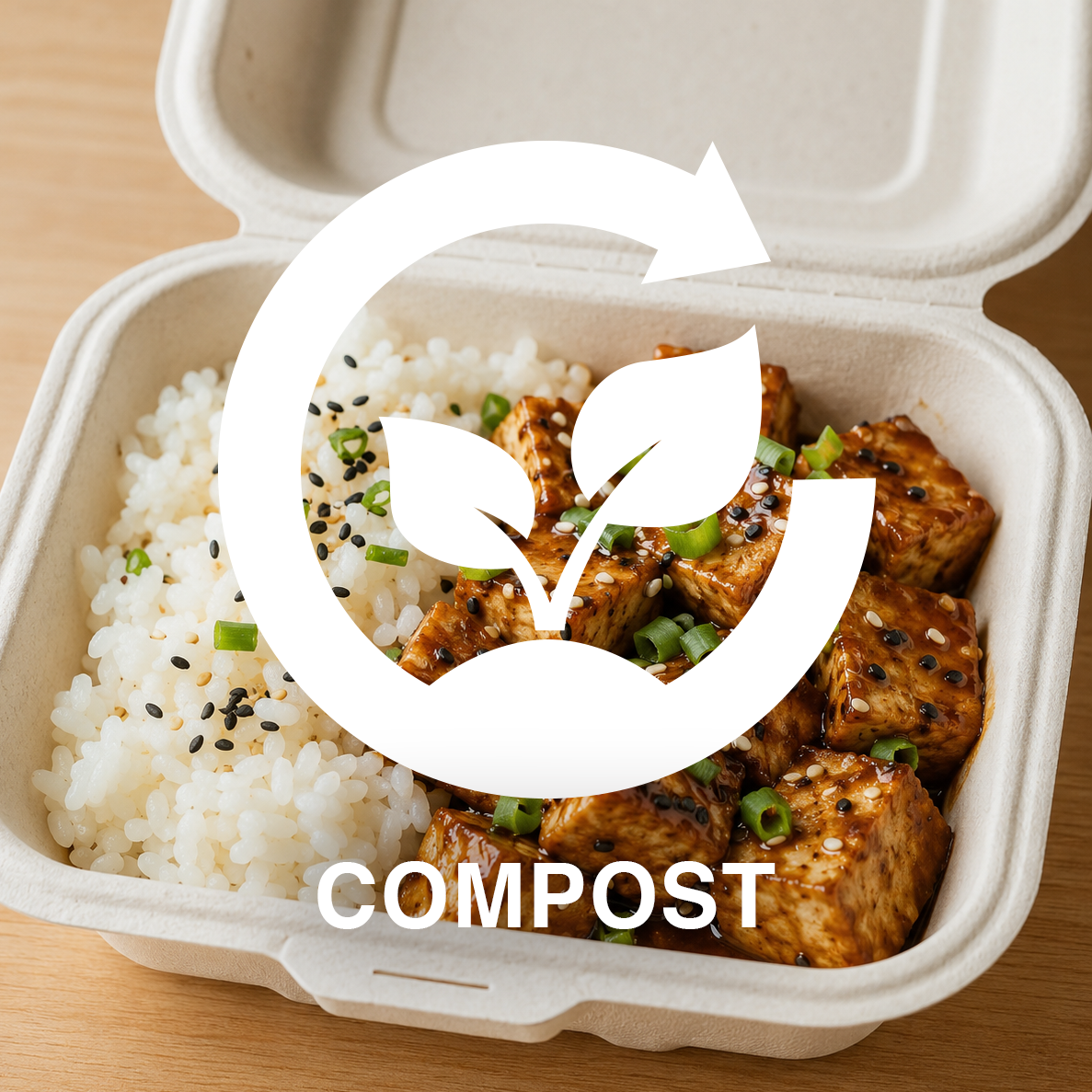
Compostable packaging can be a good fit when it matches the local composting system. It can be a bad fit when the school cannot sort it, the hauler will not accept it, or the packaging goes into the regular trash. A compostable clamshell in a landfill is still part of a disposal problem.
BPI says its certified compostable products meet ASTM compostability standards and must display the BPI Certification Mark. BPI's compostable product certification information is useful for schools and restaurant partners because it gives them a more serious starting point than vague "eco" language on a box. Certification does not remove the need to confirm local acceptance.
The EPA's environmentally preferable purchasing materials for food service ware also warn that when compostable food service ware is provided at a location, mixing other single-use ware can contaminate waste streams. EPA food service ware purchasing guidance supports the same practical point: the material choice and the bin system have to agree. Otherwise the lunchroom just created a sorting quiz for children who are trying to eat pizza.
Build the lunch program around fewer surprises
Food waste in schools is often a symptom of surprise. The restaurant is surprised by the count. The school is surprised by the delivery timing. The student is surprised by the meal. The lunch aide is surprised by the labels. The trash bin is never surprised. It has seen this episode.
A cleaner restaurant-prepared lunch program reduces surprise in a few practical ways:
- Families order from school-approved restaurant options before the cutoff.
- Restaurants see real counts by item, school, and date.
- Menus use portions and packaging that match the school day.
- Meals arrive labeled for the student and handoff path.
- Schools can watch order patterns, delivery issues, and menu feedback over time.
- Restaurant partners can adjust meals that are ordered but not eaten.
None of this sounds as exciting as a shiny sustainability campaign. Good. The most useful lunch systems are usually boring in exactly the right places.
Use a practical school food waste checklist
If a school wants to take food waste seriously without turning lunch into a research project, start with this checklist:
- Run a simple waste audit for a few representative lunch days.
- Separate unopened items, plate waste, packaging waste, and mislabeled or misdelivered meals.
- Review which menu items are ordered, which are eaten, and which return untouched.
- Ask whether students have enough time to eat before changing the menu.
- Test packaging with the students who actually have to open it.
- Confirm whether share tables are allowed and which items qualify.
- Confirm whether donation is allowed, feasible, and safe under local rules.
- Verify composting access before switching to compostable containers.
- Use certified compostable products when compostable packaging is part of the plan.
- Keep restaurant partners in the loop so menu and packaging changes are operationally realistic.
The checklist is not fancy. It is a way to stop arguing from assumptions. Schools can make better decisions when they know whether the issue is demand, timing, menu fit, packaging, sorting, or handoff.
Where Buy My Lunch fits
Buy My Lunch helps schools and restaurant partners organize the parts of lunch that often create waste: order counts, menus, cutoffs, labels, restaurant prep, delivery visibility, and handoff. Families order through the app at participating schools. Restaurants prepare meals from real orders. Schools receive a clearer path for distribution.
That structure is not a sustainability magic wand. It is better than magic: it is operational clarity. When schools and restaurants know what was ordered, who it belongs to, how it is packaged, and when it arrives, there are fewer places for the lunch program to improvise badly.
Schools can review the school setup guide. Restaurant partners can see the restaurant lunch program. The school lunch statistics page has sourced numbers on participation, costs, waste, and sustainability. For the bigger operating model, start with online lunch ordering for schools.
The best waste plan is a better lunch system
Food waste in schools deserves more than a nicer trash station. Waste comes from real lunchroom friction: rushed periods, confusing choice, overproduction, weak counts, poor packaging, bad handoff, and meals students do not want or cannot manage in time.
Composting, share tables, donation, and better packaging can all help when they fit the school's rules and capacity. But the first move is simpler: plan lunch so more of it gets eaten. That means cleaner ordering, better feedback, realistic menus, packaging that works, and a handoff that does not rely on luck.
Not glamorous. Very useful. That is school lunch operations in a sentence.
Frequently asked questions
What causes food waste in schools?
Food waste in schools can come from overproduction, rushed lunch periods, unfamiliar menu items, portions students do not want, poor ordering data, confusing handoff, unopened packaged items, and packaging that makes food hard to eat. The cause is rarely one thing. It is usually a chain of small operational decisions.
How can schools reduce food waste at lunch?
Schools can start with better counts, student input, menu testing, reasonable choice, enough time to eat, clear share-table rules, and a simple waste audit. Prevention matters most because the cleanest waste plan is the one that helps food get eaten before it becomes waste.
Are compostable containers always better for school lunch?
Not always. Compostable containers are useful only when the school has access to a composting program that accepts that specific material and the lunchroom can sort it correctly. If containers go into the trash, the label does not magically fix the waste problem.
What should restaurants know about school lunch packaging?
Restaurant partners should choose packaging that protects the meal, is easy for students to manage, works with the school's labeling and handoff process, and matches local disposal or composting rules. The package is part of the lunch operation, not an afterthought.
Can pre-ordering reduce school lunch waste?
Pre-ordering can give schools and restaurants cleaner counts before food is prepared. That does not guarantee zero waste, but it gives the lunch program better information than guessing demand at the start of the day.
How does Buy My Lunch help schools think about food waste?
Buy My Lunch organizes family orders, school-specific restaurant menus, order cutoffs, labels, restaurant preparation, delivery visibility, and handoff details. That structure helps schools and restaurant partners plan from real orders instead of relying on broad estimates.
Related posts
 School Lunch OperationsSchool Lunch Menu Template for a Real School Day
A practical school lunch menu template that helps schools and restaurant partners plan clear choices, ordering cutoffs, prep, delivery, and a reliable handoff.
 School Lunch OperationsCan You Get Food Delivered to School?
A practical guide for families and schools on when food delivery is allowed, what to check first, and how an approved lunch program keeps the handoff organized.
 School Lunch OperationsMeal Packaging for School Lunch Programs: A Delivery Checklist
A practical school lunch packaging checklist for choosing containers, labels, bags, and delivery setup that protects each meal through school handoff.