
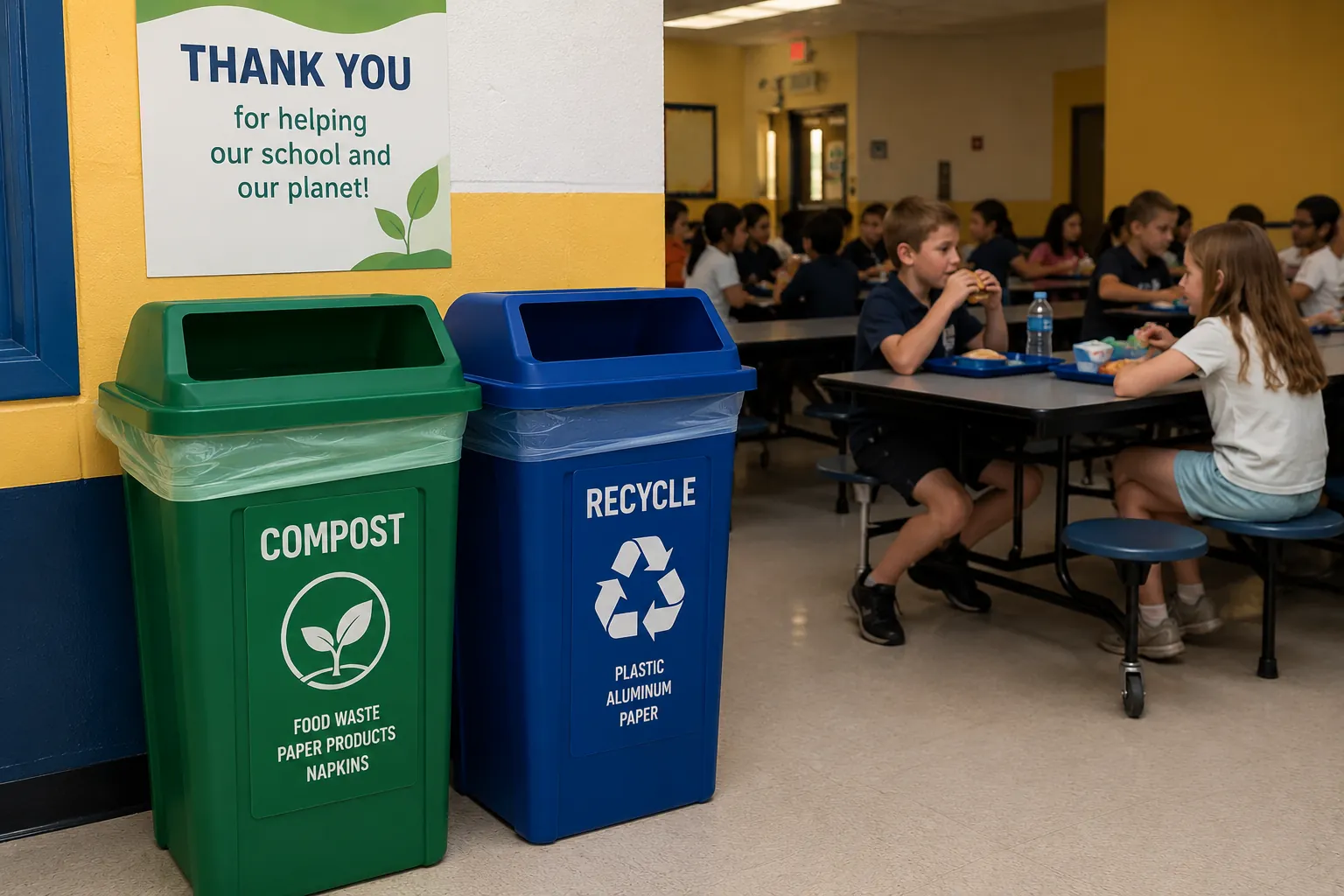
“Compostable” sounds like the easy answer. It is not. It can be a useful material choice, but only when the school, restaurant, hauler, and compost facility are working from the same rules. Otherwise a container with a leaf on the lid becomes one more thing a student has to guess about while holding lunch and looking for a seat.
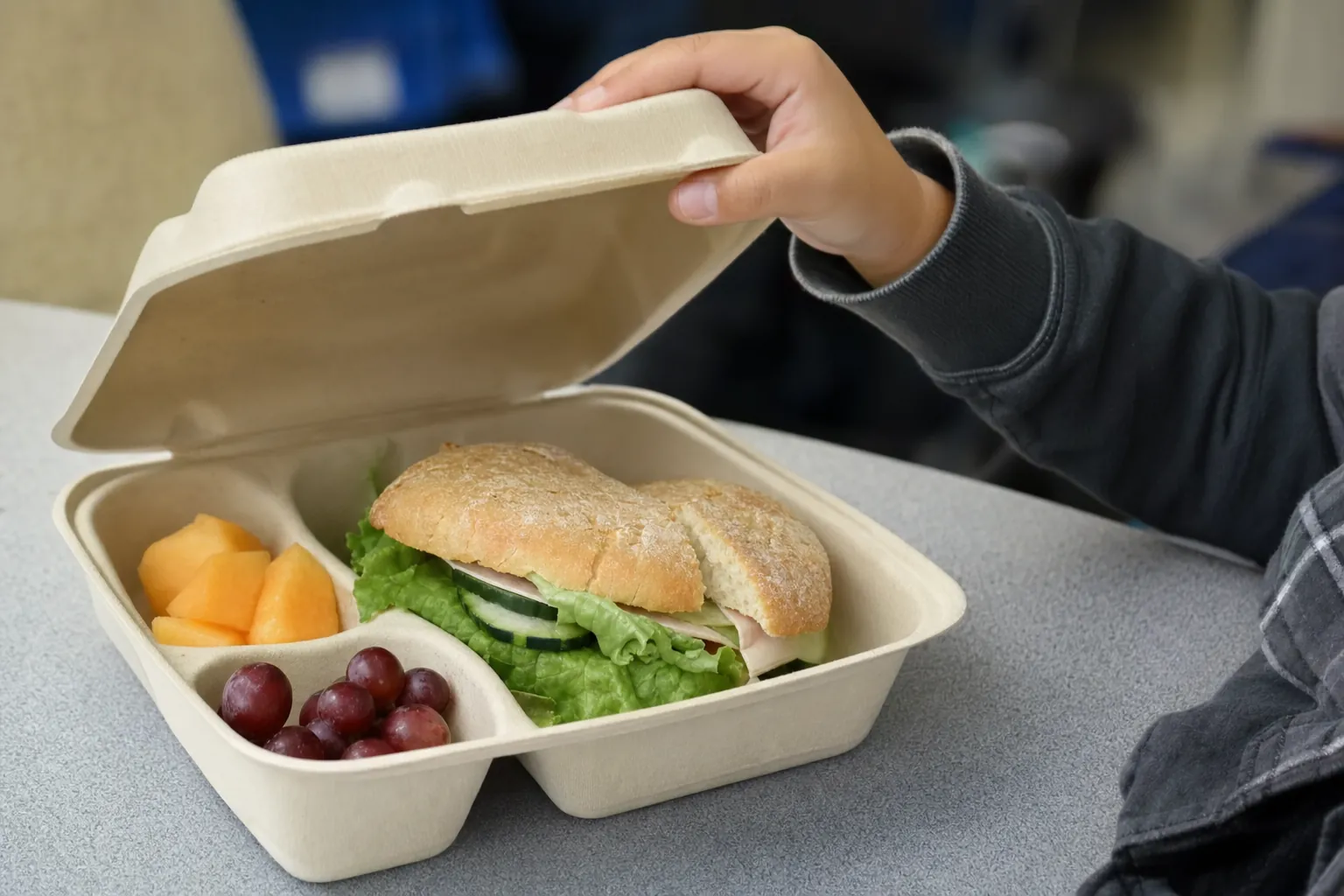
For restaurant-prepared school lunch, food containers have a real job: protect the meal, keep hot and cold items sensible, carry the student label, arrive intact, open without a wrestling match, and fit the school’s cleanup routine. Compostability is part of that decision—not a substitute for it.
Start with the local end of the story
The first question is not “Which container looks greener?” It is “What does the destination actually accept?” The EPA’s composting guidance describes composting as a managed process and places it below prevention and feeding people on the Wasted Food Scale. For a school, that means the disposal path needs to be real before packaging is changed.
Call the school’s waste provider or the compost facility and ask for its current list of accepted foodservice items. Ask whether certified compostable clamshells, lids, cups, cutlery, liners, stickers, and labels are accepted. “Compostables accepted” can mean food scraps only. A facility may have a different answer for molded fiber than it does for compostable plastic. Nobody enjoys that call. It is still cheaper than ordering a pallet of the wrong thing.
Also ask what counts as contamination. If the facility rejects mixed utensils, conventional plastic lids, sauce cups, or labels, the restaurant and school need a package design that avoids those failure points. A single stream with three nearly identical-looking containers is not a system. It is a future argument by the bins.
Know what the label is—and what it is not
“Compostable,” “biodegradable,” “plant-based,” and “eco-friendly” are not interchangeable operating instructions. The FTC’s Green Guides summary says compostable claims require competent and reliable evidence that the materials will break down into usable compost safely and in a timely manner under the conditions in which they are composted. When facilities are not available to a substantial share of buyers, the claim needs qualification.
That is why a supplier’s broad marketing language should not be the final test. Look for specific material information and, where the local program requires it, a recognized third-party certification. The BPI product catalog is one practical place to verify whether a product is listed as certified. Certification can help a school ask a sharper question; it does not force a local facility to take that product.
Keep the language clear with families and students, too. Do not tell people a container “will compost” unless the school has confirmed the path. “Place in the compost bin if your school’s program accepts this item” is less cute, much more useful.
Test the lunchroom, not just the sample box
Packaging tests often happen on a restaurant prep table with one calm adult, one meal, and plenty of space. Lunch happens with a delivery deadline, a full hallway, students who have already found the weak latch, and staff who cannot stop for a six-minute explanation of resin codes. Test the container where it will be used.
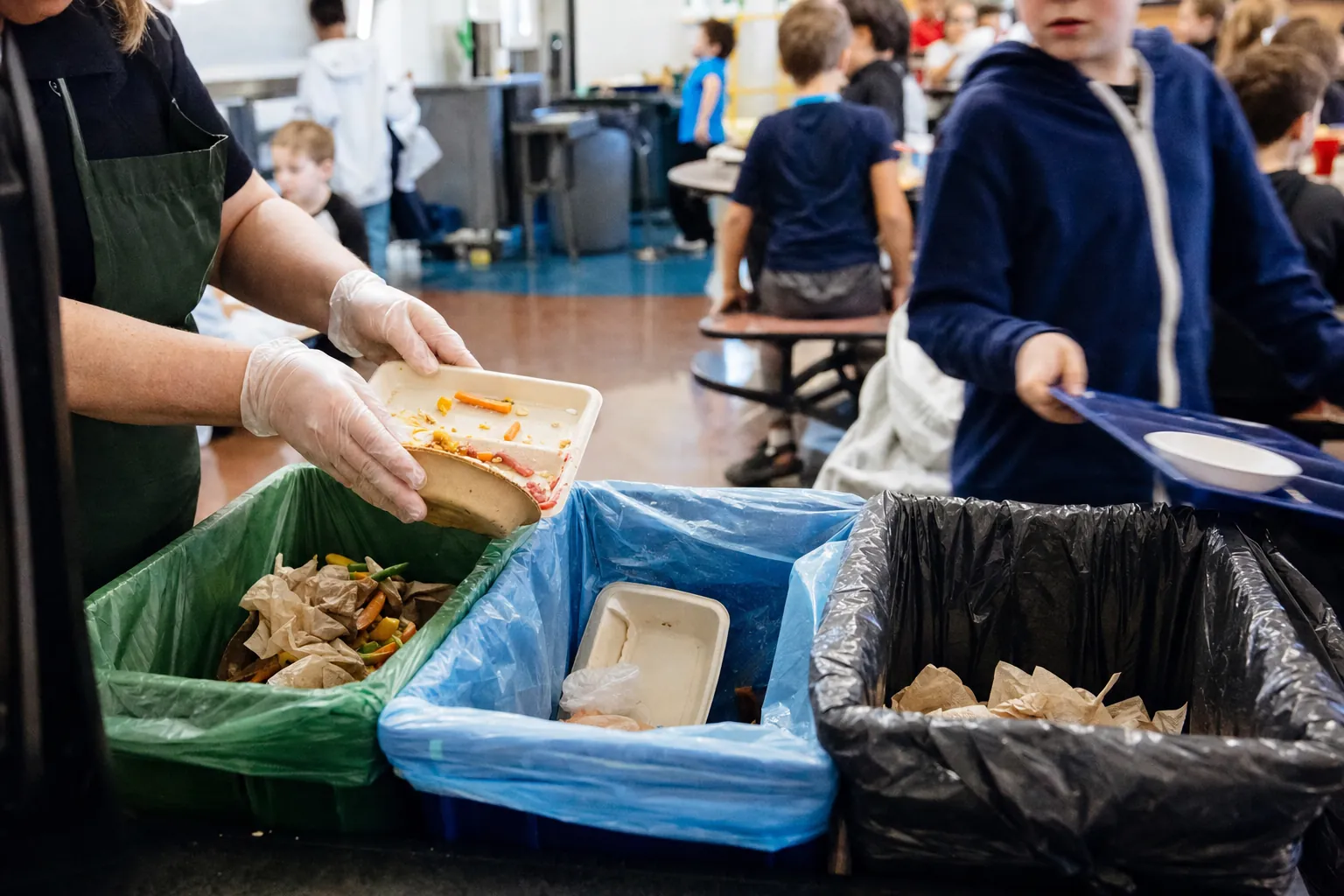
Run a short pilot with an actual menu item. Check whether the container holds moisture, keeps components separated, fits the label, stacks for delivery, and opens comfortably for the youngest students. Watch what happens after students finish: can they identify the right bin? Is there a staff member positioned to help? Are liquids, napkins, wrappers, and ordinary plastic getting mixed in?
The EPA’s student food-waste audit guide is useful here because it treats the lunchroom as something to observe rather than assume. A simple audit can separate food scraps, unopened items, packaging, and contamination. The goal is not a science fair display. It is to find the part of the process that needs fixing.
Make one person responsible for the handoff
A compostable packaging change crosses several teams. Restaurant partners choose and pack the container. School leaders set the lunchroom expectations. Custodial teams manage collection. Families may see the messaging. If nobody owns the handoff between those people, the package decision gets stranded in the middle.
Give one school contact responsibility for confirming facility rules and one restaurant contact responsibility for matching the approved packaging specification. Write down the container, lid, label, liner, and cutlery that belong in the program. When a supplier substitutes something, it should be a conversation, not a surprise discovered at 11:42 a.m.
Use packaging to support a better lunch operation
Compostable materials matter most when they support a lunch system that already takes prevention seriously. The existing food waste in schools guide covers the bigger order: help food get eaten, plan from real demand, and then improve the disposal path that remains.
Buy My Lunch helps schools and restaurant partners work from family orders, school-specific menus, cutoffs, labels, delivery visibility, and handoff details. That structure does not make a container compostable. It does make it easier to test whether a package works with the real meal, the real roster, and the real lunchroom.
A practical decision checklist
- Confirm local acceptance before selecting a product.
- Verify the exact container, lid, liner, and label—not just the supplier category.
- Use third-party certification information where the local program requests it.
- Test heat, moisture, stacking, opening, labeling, and delivery with a real meal.
- Design bins, signage, and supervision around what students can actually do quickly.
- Review contamination after the pilot and change one variable at a time.
- Keep the restaurant, school, and waste provider on the same written specification.
Key takeaways
- A compostable label describes a material and the conditions it is designed for; it is not a promise that every local composting program accepts it.
- The best first call is to the hauler or compost facility, not the packaging catalog.
- Students and lunch staff need a bin system that makes the right move obvious in a busy room.
- Packaging still has to protect the meal, open easily, carry a label, and survive the route from restaurant to school.
Frequently asked questions
Are compostable food containers recyclable?
Usually not. A school should follow its local recycling and composting instructions rather than assuming a container can go into either stream. Packaging that is accepted by a compost program may still be treated as contamination in recycling.
Do compostable containers break down in a landfill?
A compostable claim is tied to composting conditions, not ordinary disposal. The FTC says compostable claims need support for the specific conditions in which the product will be composted, and claims may need qualification when suitable facilities are not available.
What should a school ask before changing packaging?
Ask the collection provider which foodware it accepts, whether certification is required, how the material must be sorted, what contamination causes a load to fail, and whether the school has enough staff and signage for the change.
How does Buy My Lunch help with packaging decisions?
Buy My Lunch organizes school-specific menus, family orders, cutoffs, labels, restaurant preparation, delivery visibility, and handoff. That gives partners a clearer workflow for testing packaging against real meals and real order counts.
Continue the series
 School Lunch OperationsFood Waste in Schools: A Practical Lunchroom Guide
How schools can think about food waste, ordering, share tables, composting, packaging, and restaurant-prepared lunch without creating more lunchroom chaos.
 School Lunch OperationsCompostable Clamshell Containers: A School Lunch Checklist
How restaurant partners can evaluate compostable clamshell containers for heat, portions, labels, delivery, student handling, and local disposal rules.